
What is lightning and why does it happen in volcanic plumes ?
Lightning is a discharge occurring between two regions with different electric charges. At one point, a channel of ionized air forms and progresses step by step, eventually forming branches. This is called the stepped leader. If a positive leader meets a negative leader, a continuous conductive path is formed. The intensity of the electricity discharge increases dramatically, generating a return stroke which is much brighter than the stepped leaders.

To generate lightning, electrical charges must be split in two distinct regions. In thunderstorms, charges are carried by water droplets, graupel and ice. In volcanic plumes, charges might be carried by ash particles or gas. In both cases, particles have to be charged and subsequently separated.


The particle charging:
There are two main ways to charge ash particles:
- The most familiar mechanism is known as triboelectrification which occurs when two particles rub against each other. A common everyday example is rubbing a balloon against a wool pull-over which results in making you hair stand on end.
- The second mechanism describes the fragmentation of a particle, so that one particle carries more positive charges and the other part more negative charges. This process is called fractoelectrification.
One goal of our study is to see which effect is predominant in the charging of ash clouds.
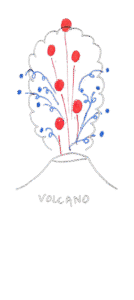
The segregation:
For some poorly understood reasons, big particles tend to be positively charged while small ones tend to be charged negatively. Due to their different mass, these two kind of particles behave differently in the jet.
The discharge:

At a certain point, the charge difference between the two regions of the plume becomes so large that the air can no longer preserve the insulation. A channel of ionized air begins to form in the negatively charged region. Because ionized air is far more conductive than its surroundings, the electrical current will concentrate within this channel – the so called leader. If it connects with the ground, a returned strike has formed. A flash has occurred !